 Rural pharmacies identified and screened thousands of patients at risk of stroke and heart disease as part of a collaboration between the NCPA Innovation Center, CPESN®, and Bristol Myers Squibb. The data was collected over six months at 25 pharmacies across the “Stroke Belt,” a group of states known for high prevalence of cardiovascular disease.
The program, which was carried out in Alabama, Arkansas, Kentucky, Louisiana, Mississippi, and Missouri, resulted in the pharmacies identifying nearly 10,000 at-risk patients. They had over 11,000 encounters with those patients, over 6,100 of which happened within the pharmacy, and made more than 20,000 interventions in just six months.
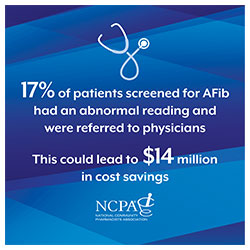
Part of the program entailed training pharmacy technicians as pharmacy-based community health workers, allowing them to help identify and engage patients with chronic disease. Among the patients screened for stroke risk, roughly 2,700 received education from pharmacy staff, and another 267 were referred to a physician for follow-up care. Among those screened for atrial fibrillation, pharmacy staff detected 400 whose heart rhythm was abnormal. Eighty-one percent were referred to a physician. Fifteen percent didn’t have a primary physician, so pharmacy staff found one and made a referral.
“In this part of the country, like most of rural America, independent community pharmacies are often the only accessible health care providers,” said NCPA CEO Douglas Hoey. “Many people in these areas may not have ready access to a doctor, but they frequently visit their local pharmacy. So, the local pharmacist is in a good position to identify at-risk patients, provide screening and counseling, connect patients with social services, and refer them to physicians for medical care so they can maintain or even improve their quality of life.”
Strategic planning for a second phase of the study is underway. Learn more about the results in our press release, and see a detailed report, poster, and other resources on the initiative here.