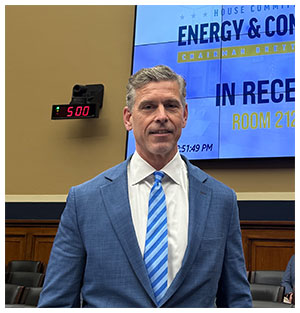
 NCPA CEO Douglas Hoey testified yesterday at a hearing of the House Energy and Commerce Subcommittee on Health on the drug supply chain. Independent community pharmacists got plenty of shoutouts from members of Congress, with Subcommittee Chairman Morgan Griffith (R-Va.), Committee Chairman Brett Guthrie (R-Ky.), and Rep. Buddy Carter (R-Ga.) lauding the passage of NCPA policy priority legislation last week. Hoey was joined on the panel by executives from the pharmaceutical manufacturing industry, biotech, distributors, and the new president and CEO of the Pharmaceutical Care Management Association, David Marin.
Reps. Diana Harshbarger (R-Tenn.), Jake Auchincloss (D-Mass.), Nannette Barragán (D-Calif.), Debbie Dingell (D-Mich.), Cliff Bentz (R-Ore.), Troy Balderson (R-Ohio), Erin Houchin (R-Ind.), and Rick Allen (R-Ga.) all came in asking hard-hitting questions around why independent pharmacies and patients are worse off due to the anticompetitive tactics of PBM-insurers. At one point in the hearing, Guthrie asked Hoey how the recently passed legislation would benefit independent pharmacies.
"We had to get an act of Congress for PBMs to give us reasonable and relevant contracts in Medicare Part D," Hoey said. "Medicare Part D is the worst payer, it's a taxpayer-funded program, it's putting pharmacies out of business, so we believe this legislation can give us a shot at reasonable and relevant contracts," Hoey said.
Asked by Guthrie if he had a response to Hoey's comment, Marin responded, "Sorry, I missed the question."
Later in the hearing, Barragán asked Hoey what the consolidation of health care under large corporations meant for patients.
"If a patient is prescribed a prescription, the doctor or the pharmacist is sometimes overruled by the PBM because the PBM makes more money off of a different drug. So the PBMs are actually practicing medicine," Hoey responded. "Then, the patient is trying to get their drug, and the PBM can either block it or require a prior authorization, or they can say 'Patient, you cannot go to that pharmacy, you can only go to my specialty pharmacy.'
"So, every step of the way, through the vertical integration, patient choices are compromised, and when those patient choices are compromised, there's less competition and higher prices."
You can read Hoey's written testimony here. Click here to find out more, including how to watch.