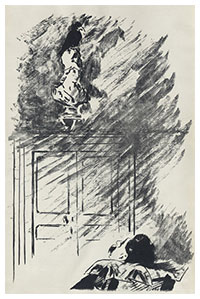
 For Edgar Allan Poe fans, today is a big day. It’s the anniversary of the 1845 publication of “The Raven” in The Evening Mirror, a now defunct New York newspaper – one of the most celebrated American poems right up there with Whitman’s “Song of Myself” and Ginsberg’s “Howl.” There’s a twist, though. Poe managed to sell his best-known poem to The American Review under his pseudonym “Quarles,” but it wouldn’t appear for another month. Perhaps unwilling to wait or (more likely) in need of more cash, Poe also sold it to the Mirror, which included his true name as the byline. It was wildly successful (later memorized by Abraham Lincoln, who would freely and faithfully recite it for friends) and Poe became a household name. What was it about the poem’s themes of devotion and madness that appealed to American and, later, international audiences? What did the raven’s refrain “nevermore” really mean? When the narrator opens with “Once upon a midnight dreary,” was this a dream-state or a moment in the true past? Historians are divided on all these points. The poem also sparked a frenzy of illustration, which accompanied different publications and different occasions, including the 1875 translation by Stéphane Mallarmé's “Le Corbeau,” which included sketches by none other than the famous painter Édouard Manet (whose illustration of the opening stanzas is pictured).
NCPA