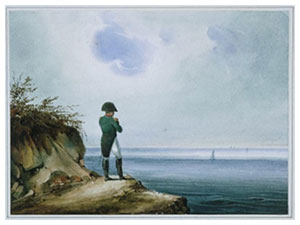
 Today in 1815, Napoleon Bonaparte began his second (and final) exile after losing to the British at Waterloo. He was sent to the island of Saint Helena, a British overseas territory that, to the European mind two centuries ago, was considered the middle of nowhere to prevent him from escaping. (None other than Oliver Cromwell granted the British East India Company a charter in 1657 to govern Saint Helena, which was settled in the following years by planters, but it was first sighted by the Portuguese more than 150 years earlier.) Napoleon famously complained about the island’s topical climate and his “prison,” the hilltop estate Longwood, which catches the brunt of the unrelenting trade winds. The deposed emperor spent most of his time reading alone in his bedroom despite the rather capacious layout of the estate, still owned by France and still flying le tricolor out front. He died there on May 5, 1821, six years after arriving. Nearly two centuries later, the writer Jean-Paul Kauffmann travelled to Saint Helena to write about Longwood and Napoleon’s exile, remarking frequently in his book about the journey to the distant island, its sights and flora and fauna, but most notably on the smell of the house itself. “There’s still a strong whiff of mildew,” he wrote, “made a little less unpleasant by creosote, the sooty smell that comes from old fireplaces. Captivity is, first of all, a smell.” As a reporter, Kauffmann would know, having spent three years in a Beirut prison, blindfolded and chained, while on assignment. Pictured: “Napoleon's Exile on Saint Helena,” an 1820 painting by Franz Josef Sandman (public domain).
NCPA