
America’s Pharmacist Feature II
WHAT TO DO ABOUT PHARMACY DESERTS?
The number-one subject expert breaks it all down
 As the presence of pharmacies has waned in many communities across the country, it has become all the more important to track how accessible pharmacies are to everyone and anyone who needs them. The Pharmacy Access Initiative, a joint project of NCPA and the University of Southern California Mann School of Pharmacy and Leonard D. Schaeffer Center for Health Policy and Economics, was created to fill that purpose by generating information and conducting research that policy officials, academics, industry leaders, and others can use to identify and address the unmet need for access to pharmacy services across the country.
Dima Mazen Qato, PharmD, MPH, PhD, is the co-director of the initiative. She is an associate professor at the University of Southern California who researches access barriers to essential medications to help eliminate disparities in health outcomes.
America's Pharmacist® spoke with Dima to better understand how reduced pharmacy access affects patients, communities, and pharmacies, and to learn more about potential solutions.
One of the leading scholars on pharmacy access, Dima was the originator of the term “pharmacy desert” — so that's where we started.
WHAT, TECHNICALLY, ARE PHARMACY DESERTS?
“A pharmacy desert is a neighborhood where the majority of the population has to travel further to their nearest pharmacy. For urban areas, we define that as having to travel more than one mile. For a suburban area, it's more than two miles. And for rural ones, it's over 10 miles. So, it's a neighborhood where residents don't have convenient access to a community pharmacy.
“A pharmacy desert can emerge when pharmacies consistently do not open in a neighborhood or when pharmacies that used to operate or serve a community end up closing. Pharmacy closures are a key cause of — mostly in the last 10 years — the worsening of pharmacy deserts across the country.”
WHAT ARE THE ROOT CAUSES BEHIND THE WORSENING OF PHARMACY DESERTS?
“Pharmacies not being incentivized to open in underserved or historically marginalized neighborhoods. We first discovered the extent of pharmacy deserts in low-income, Black or Hispanic neighborhoods in Chicago. There are neighborhoods that never had a pharmacy open, even though these neighborhoods have older populations, sicker populations, many of which are covered by Medicare or Medicaid. There is clearly a need that is not being met. There's no financial incentive for a pharmacy — or requirement — for a pharmacy to open.
“Pharmacies are, in large part, businesses, and they operate based on where the market is. And if a neighborhood is largely publicly insured, we found that there are fewer pharmacies there, and that the pharmacies that do exist are more at risk of closing, many of which are independent pharmacies.
“If there is going to be a pharmacy nearest to a neighborhood that is a pharmacy desert — especially in large cities, but also in rural areas — it's most often an independent pharmacy. Even when they try to open and enter this very challenging market, it's hard for them to survive, so they end up closing.”
WHAT MAKES IT HARD FOR THEM TO SURVIVE?
“Simply put, it's the profit margin for [prescriptions], especially since PBMs have been taking the lead in designing pharmacy networks and determining how much a pharmacy gets reimbursed, whether it's for Medicare or Medicaid or even commercial plans.
“Independent pharmacies have often been excluded from networks, reimbursed less for prescriptions, and therefore, they're often closing or have no market to enter that's going to be predictably profitable.”
WHAT ARE SOME OTHER CHALLENGES?
“I also think 340B is an important federal program. My team and I have found when partnering with independent pharmacies to operate in some neighborhoods that would otherwise be pharmacy deserts, that it's often very hard to get a 340B contract. Often, it's not possible, because these contracts are usually with chain pharmacies. So covered entities, hospitals, and clinics cannot contract with independent pharmacies, even those who are willing to open in a disproportionately publicly insured neighborhood.”
YOUR RESEARCH SPECIFICALLY IDENTIFIES CRITICAL ACCESS PHARMACIES. WHAT ARE THEY, AND WHY ARE THEY IMPORTANT?
“We felt it was important to identify not just neighborhoods that lack convenient access to pharmacies, but also pharmacies that serve those neighborhoods. A critical access pharmacy is the nearest pharmacy to a pharmacy desert, or a pharmacy that serves a neighborhood that may not be a desert, but would become one if that pharmacy closes.
“Our definition of critical access pharmacies includes independents, but it could also include some regional chains or larger chains that are not affiliated with PBMs.
“So critical access pharmacies should be prioritized and protected from closing, because if they do close, the population living there that relied on that pharmacy will now have to travel even further to get to another pharmacy. And if it's in a neighborhood that's not a pharmacy shortage area, if that pharmacy closes, they will become one.”
WHAT MAKES WORKING AT A CRITICAL ACCESS PHARMACY DIFFERENT FROM OTHER PHARMACIES?
“If you're running a critical access pharmacy, you'll probably be serving more Medicaid patients. You'll probably be serving more Medicare patients. You may not be a preferred pharmacy for many patients you are serving and dispensing prescriptions for. You may have low reimbursement rates. You might not be a 340B contract pharmacy. And you may be filling fewer prescriptions, or you're not filling the high-revenue prescriptions that you see in some locations. So, all in all, you're at risk of closure, especially if you're an independent, even if you intend to stay open.
“But for these critical access pharmacies, what we see in our data is that they're more likely to be serving these lower-income, publicly insured patients, more Black or otherwise minority patients. Sometimes they have older patients — it really depends on the neighborhood. It could be older Medicare, it could be younger Medicaid or dual eligible patients. But often they're chronically ill patients.”
HOW DO YOU THINK POLICYMAKERS COULD HELP CRITICAL ACCESS PHARMACIES SURVIVE, OR EVEN THRIVE?
“Critical access pharmacies — and I'm not sure of this, this isn't something that we have captured in our data and our analysis — is that there could also be an opportunity for them to not just continue to be open, but to maybe increase their hours of operation. There could be incentives or policies that provide more reimbursements for these pharmacies that are not only at risk for closing, but also serving more vulnerable populations, whether they're in urban or rural areas.
“The main one is ensuring that any plans participating in Medicaid or Medicare include critical access pharmacies in their networks if they don't have preferred networks, and include them in their preferred networks if they do have them. And they should be reimbursed at a higher rate, or at least at a similar rate to other pharmacies in those networks.”
SOME STATES HAVE STEPPED UP. CAN YOU TALK ABOUT THAT?
“Illinois and Oregon have critical access pharmacy payment programs that use these thresholds as targets for programs that increase reimbursement or provide payments. It doesn't have to be based on prescription volume, it could be additional payments to the pharmacy.
“Illinois implemented a critical access pharmacy payment program for additional payments for Medicaid prescriptions filled at critical access pharmacies, and also implemented the Illinois Pharmacy Support Program, which will provide around $57,000 for each of the 434 pharmacies at risk for closure. These are more innovative state policies while we wait for Medicare and Medicaid to increase reimbursement.
“Pharmacies need additional payments that are not only linked to their prescription volume to stay in operation, but to provide services the community needs, whether it's vaccinations, prescribing, and stocking specific medications, or something else. It depends on the needs of the local population.”
HOW CAN INCREASED REIMBURSEMENT PROVIDE IMPROVED PATIENT OUTCOMES?
“I think another part, which I know gets a lot of attention in the pharmacy community, is reimbursement for pharmacist services. I think it's important because it's revenue, and it potentially could improve patient outcomes. It provides services that are critical. And we discovered very quickly during the COVID-19 pandemic that you could just go to the pharmacy and get your vaccines, right?
“But I would caution that when we think about pharmacy services, we should also think about pharmacies that provide them. It's important for pharmacists to provide these services, but it's also important for pharmacies to be there to provide these services as well as the medications to the community.”
WHAT VALUE DOES PARTNERING WITH NCPA BRING TO THE INITIATIVE?
“Given that independent pharmacies are more likely in most states to be a critical access pharmacy than chains, the partnership is critical in trying to understand the challenges in the independent pharmacy landscape and why deserts happen, without just relying on data. It adds stories behind the numbers and the maps. That's been really valuable. Sometimes that lines up perfectly with what we see in our research, and sometimes it adds additional insights that help us do our work better.
“Working with NCPA has been critical in dissemination of our research and also developing our designations for pharmacy shortage areas in a way that involves pharmacy owners and people who are working with NCPA, and that gets policymakers to prioritize how those owners view pharmacies, at the national, state, and county and local levels.”
HOW HAS IDENTIFYING DISTANCES BETWEEN PHARMACIES MADE A DIFFERENCE WITH POLICYMAKERS?
“I think one of the things that we learned in identifying the distance, what we call thresholds for pharmacy deserts — one mile, two miles, 10 miles — that has influenced legislation where those thresholds have been used. This is not just us, it's really NCPA and its work directly with public policy officials in Congress, informing them of the years of work to come up with these thresholds at the neighborhood level. And they were used to identify essential retail pharmacies that now are an official designation of pharmacies. We'll see where that goes.
“NCPA is often the one facing state agencies, including Medicaid agencies, and sharing the insight from the tool with them. And it's helped some state pharmacy associations better advocate for independent pharmacies in their local policy and public discussions and helped my team think more practically about policy recommendations that we provide in our own published work and in our messaging.”
For more coverage...
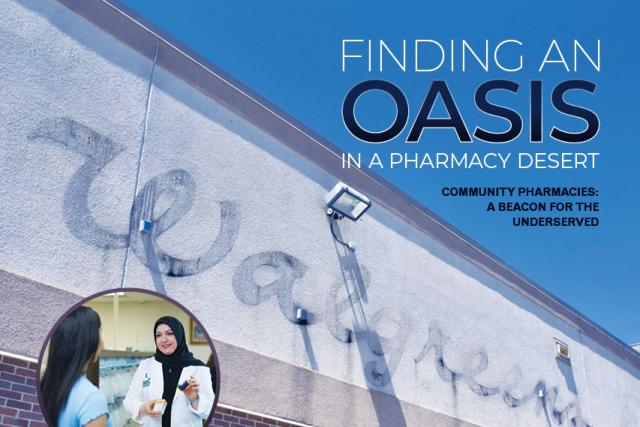
This interview is part of our coverage of pharmacy access in the October 2026 issue of America's Pharmacist®, the official magazine of the National Community Pharmacists Association (NCPA). In it, we delve further into the experiences of pharmacists working in underserved parts of Milwaukee.